So I'm already a day late with this post, and the worst part is that this week we meal planned on Sunday and I went grocery shopping that night after hubby and the kids were in bed (the benefits of a grocery store that's open 24/7). Also, this is a weird week, because I will be gone Friday through Tuesday of next week (so next week will be late as well). In the future, I will try and price out everything, but I'm not sure I even have receipts going back that far for some of this stuff.
I was going to do an introductory post all about meal planning, but that may have to wait for week after next, when I can actually sit down and wrap my brain around how I meal plan, including how to shop deals, shop your pantry/freezer/fridge, and so on. I'm also planning a post about a waste log, so stay tuned for that as well.
So without further ado, here is my meal plan for the week and how much I spent on groceries.
Week of April 9:
Monday: Freezer meal (White Chicken Chili, bagged salad kit, baguette)
Tuesday: Fish, brussel sprouts
Wednesday: Leftovers or freezer meal (TBD)
Thursday: Slow Cooker Chicken Parmesan Pasta (Recipe here)
Friday: Airport food/late dinner
Saturday: Dinner with friends
Sunday: Dinner with friends
Grocery Total for the Week: $17.61 (Savings: $8.56) at Meijer
Actual money spent per meal:
Monday: White Chicken Chili - free from hubby's parents, Bagged Salad Kit - $4.49 from Meijer, Baguette - price unknown from Costco
Tuesday: Fish - free minus fishing license if hubby catches anything, Lemon: $.79 from Meijer, Brussel Sprouts - price unknown from Costco
Wednesday: either pasta and pesto - price unknown from Costco, or frozen leftovers - price unknown from previous meal
Thursday: Boneless, skinless chicken breasts - $9.33 from Meijer for 6 (will freeze 2), Crushed Tomatoes - $2.00 (for 2 cans) from Meijer, Onion - price unknown from Meijer or Costco, Dried Herbs - price unknown, Penne - $1 from Meijer, Shredded Mozzarella Cheese - price unknown from Costco, Parmesan Cheese - price unknown from Costco
Of course, my total grocery bill was not $17.61, it was $56.78, of which $3.65 was for baby food (cereal and bananas), $13.28 was for adult snacks, $17.05 was for lunch items, and $5.19 was for drinks (milk and OJ).
Tuesday, April 10, 2018


Tuesday, April 3, 2018
Homemade Baby Food
We've been making most of our own baby food. Why? It's cheaper and we control what goes in it.
Think about costs. We really like the Beech-Nut baby food jars, which run about $0.95 per jar for a 4 oz. jar. We still buy them when we see them on sale, because they are convenient to take with on trips. However, for day-to-day use, we make our own and freeze it.
To do the math, our kiddo eats about 4 ounces (1 jar) per meal twice a day (sometimes more, she also get Cheerios, bread ends, and whatever other soft veggies and fruits we might be eating). Over the course of a week, that's about 14 jars of baby food (so about $13.30). A head of cauliflower is $3.69 at our local Meijer, and yields about 20 1.5 ounce cubes (or 30 ounces/about 7.5 jars), so for about $7 you can make the same amount of food that you would get for $13.30. And that's one of the more expensive types of produce. Sweet potatoes are about $1 per lb., so for $4 you can get about 56 ounces of food. Doesn't seem like a huge difference, but over the course of a year, that's about $700 in baby food jars versus about $370 on the high end or just over $200 on the low end.
 When looking for produce that will puree up well, I prefer to find ones that aren't too acidic (so no mandarin oranges, rhubarb, pineapple, etc.) and don't have a huge water content (watermelon, oranges, etc.). I prefer to have several different types on hand so that I can mix and match 2-3 cubes per bowl. Some of our favorites include cauliflower, zucchini, sweet potato, acorn squash, butternut squash, carrots, apples (apple sauce), turnips, bananas, and parsnips.
Something to watch out for is the Dirty Dozen. They are foods that you really should buy organic, because the regular version uses a crazy amount of pesticides. And while those might be fine for most adults to eat (with some washing), you probably don't want to expose your 6+ month old to those levels. Here's the full list (anything over 20 or so, you can probably buy regular, but it's good to be informed, regardless. It's up to you to make choices for your child).
Once cooked and pureed, I like to freeze them in 1.5 ounce portions in my WeeSprout freezer trays (silicone, top rack dishwasher safe, with a clip-on lid). Once frozen, I transfer them to a freezer bag (although freezer safe containers would work too) and stash the freezer bags in a bin from IKEA. Make sure to label and date what's in the container/bag.

To reheat them, I put them in a glass bowl (usually 2-3 cubes of whatever combo strikes my fancy - but I like to put more watery things like zucchini with at least one cube of drier stuff like cauliflower or sweet potato), and heat them up in the microwave. For my microwave, I do 1:15 for two cubes and 1:25 for three cubes, but test your own. The goal is to melt enough of the food so you can stir the rest of the frozen stuff into it, which melts and cools down the nuclear hot food enough that it's edible (or almost edible with a bit of blowing). Always make sure you test the food before you feed it to your baby, because temperatures may vary even from batch to batch and bowl size to bowl size.
If you have a baby (like I do), who is a bit underweight, our pediatrician recommended adding some olive oil into pureed foods. Although we don't ever add salt to our purees, we are not shy about adding other spices, like nutmeg, pepper, cinnamon, and so on.
So, here is my first recipe:
Butternut Squash Recipe
Ingredients:
2 Butternut Squash (medium to large)
Olive Oil
Nutmeg (optional)
Rosemary (optional)
Ground black pepper (optional)
Directions:
1) Preheat the oven to 400 degrees F.
2) Cut the squash in half lengthwise and scoop out the seeds (I like using my metal ice cream scoop for this task).
3) Place the squash flesh side up on a baking sheet and sprinkle with olive oil (if you want additional olive oil for calorie loading, I like to pour a good amount in the middle of each squash and then use my hands to distribute the oil over the squash).

4) Sprinkle with any seasoning/spices you choose and bake for 45-50 minutes or until the flesh is tender.
5) Scoop out the flesh, being careful not to get any shell (I again used my ice cream scoop), and puree in a food processor or with an immersion blender. Add additional olive oil, if desired.
6) Feed some to your kiddo once it cools down and freeze the rest.
Yields about 20 1.5 ounce cubes, depending on the size of the squash. And actually tastes pretty decent even to me, although I would prefer a bit more salt and less olive oil.
Think about costs. We really like the Beech-Nut baby food jars, which run about $0.95 per jar for a 4 oz. jar. We still buy them when we see them on sale, because they are convenient to take with on trips. However, for day-to-day use, we make our own and freeze it.
To do the math, our kiddo eats about 4 ounces (1 jar) per meal twice a day (sometimes more, she also get Cheerios, bread ends, and whatever other soft veggies and fruits we might be eating). Over the course of a week, that's about 14 jars of baby food (so about $13.30). A head of cauliflower is $3.69 at our local Meijer, and yields about 20 1.5 ounce cubes (or 30 ounces/about 7.5 jars), so for about $7 you can make the same amount of food that you would get for $13.30. And that's one of the more expensive types of produce. Sweet potatoes are about $1 per lb., so for $4 you can get about 56 ounces of food. Doesn't seem like a huge difference, but over the course of a year, that's about $700 in baby food jars versus about $370 on the high end or just over $200 on the low end.
 When looking for produce that will puree up well, I prefer to find ones that aren't too acidic (so no mandarin oranges, rhubarb, pineapple, etc.) and don't have a huge water content (watermelon, oranges, etc.). I prefer to have several different types on hand so that I can mix and match 2-3 cubes per bowl. Some of our favorites include cauliflower, zucchini, sweet potato, acorn squash, butternut squash, carrots, apples (apple sauce), turnips, bananas, and parsnips.
Something to watch out for is the Dirty Dozen. They are foods that you really should buy organic, because the regular version uses a crazy amount of pesticides. And while those might be fine for most adults to eat (with some washing), you probably don't want to expose your 6+ month old to those levels. Here's the full list (anything over 20 or so, you can probably buy regular, but it's good to be informed, regardless. It's up to you to make choices for your child).
Once cooked and pureed, I like to freeze them in 1.5 ounce portions in my WeeSprout freezer trays (silicone, top rack dishwasher safe, with a clip-on lid). Once frozen, I transfer them to a freezer bag (although freezer safe containers would work too) and stash the freezer bags in a bin from IKEA. Make sure to label and date what's in the container/bag.

To reheat them, I put them in a glass bowl (usually 2-3 cubes of whatever combo strikes my fancy - but I like to put more watery things like zucchini with at least one cube of drier stuff like cauliflower or sweet potato), and heat them up in the microwave. For my microwave, I do 1:15 for two cubes and 1:25 for three cubes, but test your own. The goal is to melt enough of the food so you can stir the rest of the frozen stuff into it, which melts and cools down the nuclear hot food enough that it's edible (or almost edible with a bit of blowing). Always make sure you test the food before you feed it to your baby, because temperatures may vary even from batch to batch and bowl size to bowl size.
If you have a baby (like I do), who is a bit underweight, our pediatrician recommended adding some olive oil into pureed foods. Although we don't ever add salt to our purees, we are not shy about adding other spices, like nutmeg, pepper, cinnamon, and so on.
So, here is my first recipe:
Butternut Squash Recipe
Ingredients:
2 Butternut Squash (medium to large)
Olive Oil
Nutmeg (optional)
Rosemary (optional)
Ground black pepper (optional)
Directions:
1) Preheat the oven to 400 degrees F.
2) Cut the squash in half lengthwise and scoop out the seeds (I like using my metal ice cream scoop for this task).
3) Place the squash flesh side up on a baking sheet and sprinkle with olive oil (if you want additional olive oil for calorie loading, I like to pour a good amount in the middle of each squash and then use my hands to distribute the oil over the squash).

4) Sprinkle with any seasoning/spices you choose and bake for 45-50 minutes or until the flesh is tender.
5) Scoop out the flesh, being careful not to get any shell (I again used my ice cream scoop), and puree in a food processor or with an immersion blender. Add additional olive oil, if desired.
6) Feed some to your kiddo once it cools down and freeze the rest.
Yields about 20 1.5 ounce cubes, depending on the size of the squash. And actually tastes pretty decent even to me, although I would prefer a bit more salt and less olive oil.
Wednesday, March 21, 2018
Comparison Shopping
Since we are on an even tighter grocery budget, I want to make sure that I'm getting the best deals on food and other staples that we need. To that end, I made a comparison list (which you are welcome to download). I made the original list in my bullet journal, but you can type out some of the staples on the computer, print out the list and then fill in as you go. Or keep it on your phone (I like Excel documents that I can pull up from Dropbox on my phone - just remember to make it available offline before you leave wifi range).
Let's go through some things to look out for as you add to your list.
Stores: I compared prices at Meijer, Family Fare, Fresh Thyme, Sam's Club, Costco, and Aldi, since those stores are local to me. Aldi is a bit of a hike, as is Fresh Thyme, and Sam's Club and Costco are membership based (but each of our parents has access to one of those membership, so yay for us. If you're on a tight budget, you may want to find a friend with a membership or split one with someone). I also want to find a few local farmer's markets when the weather gets warmer, so I can compare prices there. Even if you think Whole Foods, Fresh Thyme, an organic market, or a farmer's market are out of your budget, you might want to go through and fill out your list there, since it may surprise you (for example, produce at Fresh Thyme is cheaper even than Meijer, I've found, and they often run specials).

Name: I am using this as the generic type (i.e. apples, rice, laundry detergent, beef, etc.).
Brand: This is the specific type. Fresh v. frozen, the fresh is the default for me, so I don't bother adding fresh behind produce, however I'll add it to mozarella because the default there is shredded/bagged (figure out what your defaults are and enter data accordingly). I buy most produce fresh, but I do buy frozen corn, so that would be Name: Corn, Brand: Frozen. Then also the sub-type, so Fuji, Pink Lady, Honeycrisp for Apples. Or the actual brand, i.e. the frozen juice we buy would be "Frozen, Old Orchard" or "Frozen, Minute Maid."
Quantity: the size it comes in, or the amount the price applies to. Some common ones - oz. (ounce), lb. (pound), ea. (each), 2L (2 Liter), can, 8 oz., etc. When it comes to cans and packages, I prefer to write down the amount in the can or package, because can and package sizes can vary. Often the signs will also tell you in very small print what the price per each or price per ounce is, so then I'll just do oz. and write down the per ounce price under the applicable store. Where quantities differ from store to store, this is especially important.
Under each store you chose: put down the dollar amount. If you are looking at by the pound ground beef, make sure you are comparing similar types of ground beef (85/15 versus 70/30 are going to be different), check the quantity on all packages so you're not comparing a 18 oz. bag at one store with a 22 oz. bag at another, also, check the value packs, those generally have the lowest prices. I write down whatever is lowest, knowing that if I do decide to buy something it will be the value pack and then I'll just break it up into smaller bags and throw the extra in the freezer for another meal.
Here is a portion of my list. I haven't filled out everything for every store. And as you can see, I am comparing pounds of lemons at Meijer and Family Fare to by the each at Fresh Thyme, so that's a little problematic.

To simplify your list: I like to go through and divide out differing amounts, so if Family Fare has 4 peppers for $5, I try to get it down to by the each. I also like to divide out by the size of the packs, so that I'm comparing ounces to ounces instead of a 18 oz. pack to a 32 oz. pack. If I look at two different sizes of the same cat food, and one is clearly cheaper, I remove the more expensive one from the list. Same with name brands, unless we greatly prefer one over the other, I'll remove the more expensive one. Don't forget to compare you favorite brand of toothpaste, deodorant, etc. although you may want to add some drug stores or a pet supply store into the mix for better comparison purposes.
How to use the list:
Knowing what to buy where. I'm not saying you need to go to every grocery store every week. That would negate your savings in gas and wear and tear on your car. I alternate going to Costco and Sam's Club once a month. After comparing prices between Family Fare and Meijer, I'll probably drop Family Fare from my list completely, because Meijer is cheaper across the board for my weekly shopping trip. And Aldi is only worth a trip if I know that several of the things I need that week are significantly cheaper than at Meijer, or if I want to stock up on fruit snacks, cereal bars, or pop tarts and other things that won't go bad very quickly.
Having a baseline idea of what things cost is helpful when you see a deal. Even if I go into Meijer for five things, I usually buzz by the meat section to see if they have any really good deals. Or you can read the online sales leaflets (or the paper ones, if you get those in the mail). We get most of our meat from Costco or Sam's Club, because it's just cheaper there and our chest freezer is rather large. However, sometimes the Meijer deals will blow the base prices at the other stores out of the water, and then I'll buy one or two to throw in the freezer. Spend a little money now to save a lot later on. Just make sure you're not buying something only because it's on sale. That's a waste of money if you're never going to eat/use it.
It's also good for comparing large amounts of things you know you'll use up, versus the smaller containers or by the each items. So if I know that Fuji apples are $1.99 per pound at Meijer for loose apples, and Sam's Club has a 3 pound bag of Fuji apples for $4, I know that it's cheaper to buy the bag (IF we are going to eat them all - i.e. I'm going to be making apple sauce or something). If you buy the bag and only eat 1 pound of apples before the rest goes bad, you've wasted money.
It lets you cost out your meals before you head to the grocery store. I meal plan and shop once a week (unless we run out of something important like milk halfway through the week). Knowing what my weekly budget is for groceries, plus what I already have on hand from shopping deals and Costco/Sam's Club, helps me when I sit down to make my meal plan. If we're really tight on money, I try to stick with the stuff we already have, plus what's cheap to buy at the store. I also try to keep a bit of wiggle room in that budget, in case I do see a really good deal while I'm out.
Buying name brand instead of generic. Sometimes I'll find a coupon or a deal so the usually more expensive name brand is cheaper or the same price as the generic. This matters mostly for things where you actually care about the taste, but maybe name brand just isn't in the budget. For me that's ice cream. I can always get generic for $2.99 a quart, but sometimes Hudsonville ice cream or Breyer's is marked down and then I like to get those instead, because I just like the taste better, but generic ice cream is better than no ice cream in my book. Also, ice cream is great freezer fodder if you have a large chest freezer like we do. Because it runs much more efficiently when it's full, we try to keep a bag of ice in there, and cheap stuff like ice cream and bread, so we're not filling it to the brim with expensive meats. The opposite may also be true. I don't like the generic Sam's Club diapers, so I buy Pampers when I go there. However, the Kirkland brand at Costco is just fine. So I like to be able to compare the lowest cost Pampers at Sam's Club with the generic (Kirkland) brand at Costco by the each by size (my kids are in Size 2 and 5 right now).
Shopping elsewhere. Maybe you stumbled across a new grocery store or a farmer's market/stand on a route you don't usually take. You've got your comparison list and your grocery list in your pocket or on your phone or in your planner. And because you're already here, it's not wasted gas because you weren't going to multiple stores.
Let's go through some things to look out for as you add to your list.
Stores: I compared prices at Meijer, Family Fare, Fresh Thyme, Sam's Club, Costco, and Aldi, since those stores are local to me. Aldi is a bit of a hike, as is Fresh Thyme, and Sam's Club and Costco are membership based (but each of our parents has access to one of those membership, so yay for us. If you're on a tight budget, you may want to find a friend with a membership or split one with someone). I also want to find a few local farmer's markets when the weather gets warmer, so I can compare prices there. Even if you think Whole Foods, Fresh Thyme, an organic market, or a farmer's market are out of your budget, you might want to go through and fill out your list there, since it may surprise you (for example, produce at Fresh Thyme is cheaper even than Meijer, I've found, and they often run specials).

Name: I am using this as the generic type (i.e. apples, rice, laundry detergent, beef, etc.).
Brand: This is the specific type. Fresh v. frozen, the fresh is the default for me, so I don't bother adding fresh behind produce, however I'll add it to mozarella because the default there is shredded/bagged (figure out what your defaults are and enter data accordingly). I buy most produce fresh, but I do buy frozen corn, so that would be Name: Corn, Brand: Frozen. Then also the sub-type, so Fuji, Pink Lady, Honeycrisp for Apples. Or the actual brand, i.e. the frozen juice we buy would be "Frozen, Old Orchard" or "Frozen, Minute Maid."
Quantity: the size it comes in, or the amount the price applies to. Some common ones - oz. (ounce), lb. (pound), ea. (each), 2L (2 Liter), can, 8 oz., etc. When it comes to cans and packages, I prefer to write down the amount in the can or package, because can and package sizes can vary. Often the signs will also tell you in very small print what the price per each or price per ounce is, so then I'll just do oz. and write down the per ounce price under the applicable store. Where quantities differ from store to store, this is especially important.
Under each store you chose: put down the dollar amount. If you are looking at by the pound ground beef, make sure you are comparing similar types of ground beef (85/15 versus 70/30 are going to be different), check the quantity on all packages so you're not comparing a 18 oz. bag at one store with a 22 oz. bag at another, also, check the value packs, those generally have the lowest prices. I write down whatever is lowest, knowing that if I do decide to buy something it will be the value pack and then I'll just break it up into smaller bags and throw the extra in the freezer for another meal.
Here is a portion of my list. I haven't filled out everything for every store. And as you can see, I am comparing pounds of lemons at Meijer and Family Fare to by the each at Fresh Thyme, so that's a little problematic.
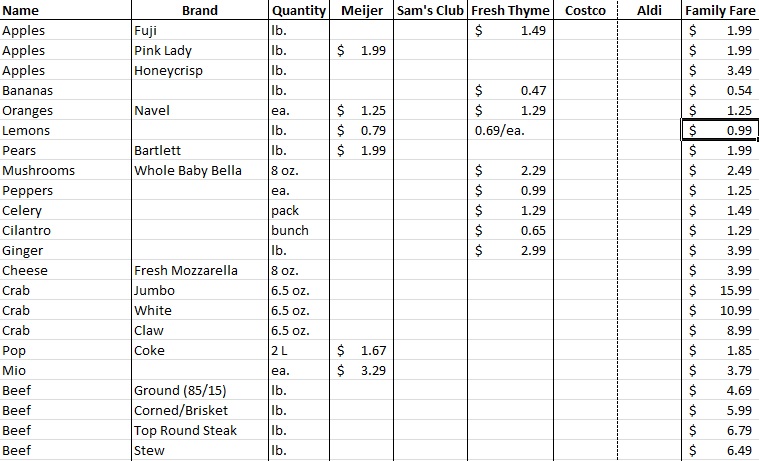
To simplify your list: I like to go through and divide out differing amounts, so if Family Fare has 4 peppers for $5, I try to get it down to by the each. I also like to divide out by the size of the packs, so that I'm comparing ounces to ounces instead of a 18 oz. pack to a 32 oz. pack. If I look at two different sizes of the same cat food, and one is clearly cheaper, I remove the more expensive one from the list. Same with name brands, unless we greatly prefer one over the other, I'll remove the more expensive one. Don't forget to compare you favorite brand of toothpaste, deodorant, etc. although you may want to add some drug stores or a pet supply store into the mix for better comparison purposes.
How to use the list:
Knowing what to buy where. I'm not saying you need to go to every grocery store every week. That would negate your savings in gas and wear and tear on your car. I alternate going to Costco and Sam's Club once a month. After comparing prices between Family Fare and Meijer, I'll probably drop Family Fare from my list completely, because Meijer is cheaper across the board for my weekly shopping trip. And Aldi is only worth a trip if I know that several of the things I need that week are significantly cheaper than at Meijer, or if I want to stock up on fruit snacks, cereal bars, or pop tarts and other things that won't go bad very quickly.
Having a baseline idea of what things cost is helpful when you see a deal. Even if I go into Meijer for five things, I usually buzz by the meat section to see if they have any really good deals. Or you can read the online sales leaflets (or the paper ones, if you get those in the mail). We get most of our meat from Costco or Sam's Club, because it's just cheaper there and our chest freezer is rather large. However, sometimes the Meijer deals will blow the base prices at the other stores out of the water, and then I'll buy one or two to throw in the freezer. Spend a little money now to save a lot later on. Just make sure you're not buying something only because it's on sale. That's a waste of money if you're never going to eat/use it.
It's also good for comparing large amounts of things you know you'll use up, versus the smaller containers or by the each items. So if I know that Fuji apples are $1.99 per pound at Meijer for loose apples, and Sam's Club has a 3 pound bag of Fuji apples for $4, I know that it's cheaper to buy the bag (IF we are going to eat them all - i.e. I'm going to be making apple sauce or something). If you buy the bag and only eat 1 pound of apples before the rest goes bad, you've wasted money.
It lets you cost out your meals before you head to the grocery store. I meal plan and shop once a week (unless we run out of something important like milk halfway through the week). Knowing what my weekly budget is for groceries, plus what I already have on hand from shopping deals and Costco/Sam's Club, helps me when I sit down to make my meal plan. If we're really tight on money, I try to stick with the stuff we already have, plus what's cheap to buy at the store. I also try to keep a bit of wiggle room in that budget, in case I do see a really good deal while I'm out.
Buying name brand instead of generic. Sometimes I'll find a coupon or a deal so the usually more expensive name brand is cheaper or the same price as the generic. This matters mostly for things where you actually care about the taste, but maybe name brand just isn't in the budget. For me that's ice cream. I can always get generic for $2.99 a quart, but sometimes Hudsonville ice cream or Breyer's is marked down and then I like to get those instead, because I just like the taste better, but generic ice cream is better than no ice cream in my book. Also, ice cream is great freezer fodder if you have a large chest freezer like we do. Because it runs much more efficiently when it's full, we try to keep a bag of ice in there, and cheap stuff like ice cream and bread, so we're not filling it to the brim with expensive meats. The opposite may also be true. I don't like the generic Sam's Club diapers, so I buy Pampers when I go there. However, the Kirkland brand at Costco is just fine. So I like to be able to compare the lowest cost Pampers at Sam's Club with the generic (Kirkland) brand at Costco by the each by size (my kids are in Size 2 and 5 right now).
Shopping elsewhere. Maybe you stumbled across a new grocery store or a farmer's market/stand on a route you don't usually take. You've got your comparison list and your grocery list in your pocket or on your phone or in your planner. And because you're already here, it's not wasted gas because you weren't going to multiple stores.
Tuesday, September 22, 2015
Date Night on a Budget
My husband and I had our six year anniversary yesterday and decided to go to Olive Garden. We are currently living on one salary (mine, while he stays home with our kid), so it just wasn't in the budget to go somewhere fancy. In fact Olive Garden wasn't even in the budget, but I decided we needed a date night without our almost seven month old. So out we went.
Since we were on a budget, we skipped the alcohol. Restaurants upcharge that like you wouldn't believe (since they sell most wines and liquor by the pour, they generally make 70-80% profit on a bottle). Instead we agreed to pull out a bottle of wine at home.

Olive Garden gives you free bread sticks and salad, so I try to fill up on those and then take part of my entree home for lunch the next day (another money saver). We also skipped the appetizer, but since my husband really wanted the calamari appetizer, he got it as his entree instead, with a soup. Appetizers are generally much cheaper options than a main course, and we got a heaping plate of calamari when a pasta dish with a sprinkling of calamari might run you almost twice that and you end up getting a bunch of pasta which is extremely cheap for the restaurant to buy. Restaurants make their money on things like pizza, pasta, and various other dishes where they have a lot of cheap "filler" so they can skimp on the expensive stuff like meat and seafood.
Since we filled up on bread sticks and salad, we also skipped the dessert. However, and this is important, if you don't have a lot of money, skip an appetizer, but do NOT skimp on the tip. That waiter or waitress worked just as hard to please us on a $32 check as she would have if we'd also gotten drinks, appetizers, dessert, and coffee. And it's not her fault that the restaurant she works for gives away unlimited bread sticks and salad to the diners. It's not fair to punish the server just because you're trying to save some money. If I have a set budget for dinner, I prefer to cut down on a drink or dessert, rather than run out of money to leave a good tip.
After our dinner we walked home, both to burn off some of the heavy calories of the pasta and bread, and to save wear and tear and gas on the car (which is actually a lie that we were telling ourselves, because the real reason why we couldn't even really afford a trip to Olive Garden is because our car needs to go in to be repaired after my recent accident and we'll be paying a $250 deductible to get it fixed). But the walk did give us a bit more time away from our kid, who was safely ensconced with a friend who'd offered to watch him (for free, because he loves our kid, and potentially in the hopes of reciprocation once he has a kid of his own, which we will be happy to do). And it gave us time to talk and just generally catch up on our day and the past year of married life.
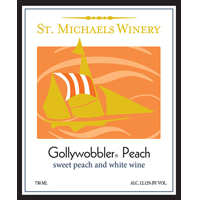
We got home and after putting our kid to bed and thanking our friend profusely (and politely shooing him out the door, after making plans with him later in the week, so we could have the rest of the evening to ourselves), we opened that bottle of wine ($12-$14 Gollywobbler Peach from St. Michael's Winery). This is way cheaper than drinking a bottle or 4-6 glasses at a restaurant any day, and amazing to boot! If you haven't had the Gollywobbler Peach, I highly recommend it if you can get your hands on it. It's made by a small winery in Maryland, and is sweet like a dessert wine but cheaper than most dessert wines, and even my husband who is not usually a sweet wine sort of guy, loves it.
We watched an episode of Leverage on the laptop, while snuggling together in bed and drinking our wine. This saved us a boatload instead of going to the movies, especially since my husband is one of those people who has to buy a drink at the concession stand when we go to a movie, and maybe some popcorn or candy too. And we were nice and cozy at home to boot. We also had access to ice cream, but since the wine was so sweet, it satisfied our cravings for dessert as well.
Since we were on a budget, we skipped the alcohol. Restaurants upcharge that like you wouldn't believe (since they sell most wines and liquor by the pour, they generally make 70-80% profit on a bottle). Instead we agreed to pull out a bottle of wine at home.

Olive Garden gives you free bread sticks and salad, so I try to fill up on those and then take part of my entree home for lunch the next day (another money saver). We also skipped the appetizer, but since my husband really wanted the calamari appetizer, he got it as his entree instead, with a soup. Appetizers are generally much cheaper options than a main course, and we got a heaping plate of calamari when a pasta dish with a sprinkling of calamari might run you almost twice that and you end up getting a bunch of pasta which is extremely cheap for the restaurant to buy. Restaurants make their money on things like pizza, pasta, and various other dishes where they have a lot of cheap "filler" so they can skimp on the expensive stuff like meat and seafood.
Since we filled up on bread sticks and salad, we also skipped the dessert. However, and this is important, if you don't have a lot of money, skip an appetizer, but do NOT skimp on the tip. That waiter or waitress worked just as hard to please us on a $32 check as she would have if we'd also gotten drinks, appetizers, dessert, and coffee. And it's not her fault that the restaurant she works for gives away unlimited bread sticks and salad to the diners. It's not fair to punish the server just because you're trying to save some money. If I have a set budget for dinner, I prefer to cut down on a drink or dessert, rather than run out of money to leave a good tip.
After our dinner we walked home, both to burn off some of the heavy calories of the pasta and bread, and to save wear and tear and gas on the car (which is actually a lie that we were telling ourselves, because the real reason why we couldn't even really afford a trip to Olive Garden is because our car needs to go in to be repaired after my recent accident and we'll be paying a $250 deductible to get it fixed). But the walk did give us a bit more time away from our kid, who was safely ensconced with a friend who'd offered to watch him (for free, because he loves our kid, and potentially in the hopes of reciprocation once he has a kid of his own, which we will be happy to do). And it gave us time to talk and just generally catch up on our day and the past year of married life.
We got home and after putting our kid to bed and thanking our friend profusely (and politely shooing him out the door, after making plans with him later in the week, so we could have the rest of the evening to ourselves), we opened that bottle of wine ($12-$14 Gollywobbler Peach from St. Michael's Winery). This is way cheaper than drinking a bottle or 4-6 glasses at a restaurant any day, and amazing to boot! If you haven't had the Gollywobbler Peach, I highly recommend it if you can get your hands on it. It's made by a small winery in Maryland, and is sweet like a dessert wine but cheaper than most dessert wines, and even my husband who is not usually a sweet wine sort of guy, loves it.
We watched an episode of Leverage on the laptop, while snuggling together in bed and drinking our wine. This saved us a boatload instead of going to the movies, especially since my husband is one of those people who has to buy a drink at the concession stand when we go to a movie, and maybe some popcorn or candy too. And we were nice and cozy at home to boot. We also had access to ice cream, but since the wine was so sweet, it satisfied our cravings for dessert as well.
Sunday, September 13, 2015
Recipe: German Bread Pudding
I have been trying to nail down my grandmother's bread pudding recipe for literally years. Unfortunately, asking her doesn't do much good as she never measures anything. Watching doesn't necessarily work because she makes it a little differently every time and doesn't stop to wait for you to measure what she's throwing into the mix, so here is the closest approximation I've found that results in a finished product close to what I'm used to eating. My grandmother always served this as the entrée with tomato soup as an appetizer.

The base for this recipe comes from this site on Traditional German Cookery, from the recipes for Bread Pudding (Old, old recipe) and Weissbrot Pudding (White Bread Pudding) by Selma Dalgety.
Ingredients:
3-4 cups dried bread cubes (or enough to fill your pan and then some)
6 small green apples, sliced into small chunks
2 cups whole milk, scalded
1/2 cup butter, melted
4 eggs, beaten so the yolks combine with the whites
1/2 cup sugar
1/2 tsp salt
1 tsp cinnamon
1 1/2 tsp vanilla extract
Instructions:
Preheat oven to 400 degree Fahrenheit.
Put bread cubes and sliced apples in a big bowl. Combine all of the other ingredients in another bowl and whisk for no more than one minute or until all ingredients have combined. Pour the liquid over the bread and apples as evenly as possible. Use your hands to mix the bread and apples until all the liquid has been absorbed into the bread. Let is sit in the fridge for at least one hour (3-4 hours is preferable) until the mixture has been absorbed partially or entirely into the bread. Grease a 9 by 13 inch pan and then fill it with the mixture and smash mixture down with your hands until it is level with the rim of the pan. Put on center rack and bake for 40-45 min. or until golden brown and crispy. Serve with canned fruit in syrup (family favorites include plums - which my grandmother used to can herself, mandarin oranges, or pears).
Tuesday, January 1, 2013
Sourcing Proteins
Just to clarify, proteins can be found in a range of foods, including green veggies like spinach, beans, tofu, lentils, quinoa, and nuts. This is how vegans get their proteins. While this may be the topic of a future post, I have never experimented with veganism and have only managed a vegetarian diet for a few days before the smell of bacon became too much to resist. In this post I am solely interested in animal-based proteins like meat, eggs, milk, and cheese. I will leave seafood for a future post as well.
Grocery stores like Whole Foods are great, because they will tell you exactly where your meats and dairy products come from. However, for those of us not blessed with a Whole Foods right around the corner, we have to make do with our generic grocery store. A few things to watch for when buying meat: local, organic, grass-fed and hormone-free. The organic certification requires that the meat be hormone free, but don't be fooled by labels that say "all natural." "Natural" unlike "organic" is not a term that is regulated, so producers slap it on there as a marketing tool. This is true for all labels, not just meats.

Cage-free is a term that is not as strictly controlled and it really only means that the chickens are kept outside of a cage, but may still be crowded into a dark barn in multiple stories. Free-range is also a term that is only partially regulated, it can mean anything from the chickens spending a few minutes outside per day to the chickens spending all day outside.
For milk and cheese, organic is also the best thing to look for. Again, this does not mean that those products are local.
Butcher Shops
Have a local butcher? Talk to them about where they source their meat from. It may or may not be local, and it may or may not be organic or grass-fed, but you won't know until you ask. Chances are good that it is at least local.
Farmer's Markets, Farm Stands
If you live in an area with a thriving farmer's market, you may be in luck. The closest farmer's market to us has several local farmers that will bring meat and dairy products to the market. Speak with your local farmers and learn how they keep their animals. It may be stereotypical, but I tend to trust the Menonites and Amish most to treat their animals humanely, but a trip out to the farm to see how the animals are kept may be in order, if you are really concerned. Small farmers also have a harder time justifying the cost of the organic seal, so there's a chance that their animals are grown organically or are at least grass-fed, so talking to them is usually the best bet. You may even be able to find some of the less popular meats, like bison.

Do you want to make your own cheeses or butter? In some states it is illegal to buy raw milk in grocery stores or even straight from a farmer. One way to get around this is to purchase a share in a dairy cow. These arrangements are usually made through a local farmer and give you access to the products of the cow directly.
Another form of cow sharing is for meat cattle. Again arrangements usually happen through a local farmer or via online sign-ups, and they deliver 1/8 to a full cow's worth of meat at butchering time. In this case, it is definitely a good idea to go visit the farm and potentially even the animal you will be getting your meat from, just to make sure that the animal is properly cared for and is grass-fed. My in-laws have been getting a 1/4 share for a few years now, and stock the meat in their chest freezer. It's some of the best meat you will find, even frozen.

Hunting
I have never hunted before, so I'm not an expert on this by any stretch of the imagination. However, if you are not gun shy and don't have a problem killing your own meat, more power to you. I don't believe in hunting for trophies or pelts, but if you're killing animals for meat, especially those that are overpopulated, I say go for it. If you are interested in starting up, make sure you know your hunting seasons, permitting requirements, gun v. bow, safety equipment, etc. Also, be sure you take someone along who knows how to butcher the animal correctly, or find a local butcher who may be willing to take apart the animal for you. Some people also set snares or traps, but I know even less about that aspect of hunting.

Backyard farming
Before considering this option, make sure you know what your local policies are. Some cities and suburbs allow you to keep meat or egg hens in your backyard (although they may have separate restrictions on roosters) or rabbit hutches. Some backyard farmers even keep goats, sheep, or pigs, again depending on local policies. Quail, pheasants, ducks, geese, and other small fowl are also options. Local policies can range from the type and number of animals, to requirements for how far shelters (coops, hutches, etc.) must be built from the property lines. Even if there are no specific laws, make sure to keep the noise, odors, and flies from annoying your neighbors. My grandmother used to raise hares in hutches for meat in the middle of the city, and a colleague has egg laying hens in her backyard. For more information on backyard farming, a great article can be found here.

Sunday, August 5, 2012
Sourcing Produce - Local and Organic
The ingredients you use to make your food are the most important thing. This is true both at home and at a restaurant. You can have the best chefs working for you, but if your ingredients are sub-par, it's just not going to be as good. It's kind of like starting with a sound foundation when building a house. This is not to say that your dish will turn out perfect if you use good ingredients: you can still screw up the recipe, burn it, or plate it in one big soggy mess.

When buying produce, my big two watch words are organic and local. Organic products are USDA certified and should have a little label on the packaging somewhere. They are produced using methods that do not involve modern synthetic inputs such as synthetic pesticides and chemical fertilizers. Organic foods are not processed using irradiation, industrial solvents, or chemical food additives. However, in the United States, these may include genetically modified organisms (GMO's).

The term "local" used in conjuction with food is not regulated like the term "organic." However, it generally refers to food that has been grown in a radius of about 100 miles. The best source for local produce is a farmer's market. The benefits of locally grown foods are legion. However, to me the most important reasons are taste (they haven't been artifically ripened and were usually picked within the last 24 hours), less fossil fuels burned to ship them to my table, and the money I spend stays in the local economy.
Usually you will have to settle for one or the other, since not all organic produce is local and not all local produce is organic. In some cases the farmers at your farmer's market may actually grow their produce in line with organic practices, but just don't have the money to pay for the USDA certification. It always helps to talk to the guys and gals manning the booths and maybe even take a trip out to a farm.

Another source for local foods is a CSA (community-supported agriculture) subscription with a local farm. You can find these by going online and searching for CSA memberships in your vicinity. CSA members or subscribers pay at the onset of the growing season for a share of the anticipated harvest; once harvesting begins, they receive weekly shares of vegetables and fruit, in a vegetable box scheme, and also sometimes herbs, cut flowers, honey, eggs, dairy products and meat. Some CSA's deliver straight to your door step, others deliver to a set spot in your city, others require that you come pick up your share at the farm. Some farms will also allow you to go and pick your own produce, especially at the end of the season when they are trying to clear their fields.
.JPG)
And of course, what better way to get fruits and veggies than by growing your own. Not only do you have control over the kind of soil you purchase, but you also know exactly what kinds of pesticides and what kinds of fertilizer you use. The best fertilizer is compost (either from your own compost heap/barrel or bought in bags) and instead of using pesticides use some diatamous earth around the outside of your beds to stop grounded pests as well as a combination of crop rotation, close monitoring to spot issues immediately, and companion planting (i.e. planting marigolds near tomatoes to keep aphids away). There are many websites and books on the subject of growing safe veggies, herbs, and fruits in your own backyard.
.JPG)
The amount of labor involved depends on the types of produce you decide to plant given the amount of time you think you will be able to put into maintaining the garden. You also don't need a huge backyard, many people make do with planters on windowsills and balconies. Climbing plants like squashes and cucumbers can also be grown in pots and then trained up a wall. Things like mint, should be grown in pots, if you don't want it to take over your whole yard. The time and effort will be well worth it when you are serving cucumber salad or mashed potatoes made from produce picked in your own garden.
When buying produce, my big two watch words are organic and local. Organic products are USDA certified and should have a little label on the packaging somewhere. They are produced using methods that do not involve modern synthetic inputs such as synthetic pesticides and chemical fertilizers. Organic foods are not processed using irradiation, industrial solvents, or chemical food additives. However, in the United States, these may include genetically modified organisms (GMO's).
The term "local" used in conjuction with food is not regulated like the term "organic." However, it generally refers to food that has been grown in a radius of about 100 miles. The best source for local produce is a farmer's market. The benefits of locally grown foods are legion. However, to me the most important reasons are taste (they haven't been artifically ripened and were usually picked within the last 24 hours), less fossil fuels burned to ship them to my table, and the money I spend stays in the local economy.
Usually you will have to settle for one or the other, since not all organic produce is local and not all local produce is organic. In some cases the farmers at your farmer's market may actually grow their produce in line with organic practices, but just don't have the money to pay for the USDA certification. It always helps to talk to the guys and gals manning the booths and maybe even take a trip out to a farm.
Another source for local foods is a CSA (community-supported agriculture) subscription with a local farm. You can find these by going online and searching for CSA memberships in your vicinity. CSA members or subscribers pay at the onset of the growing season for a share of the anticipated harvest; once harvesting begins, they receive weekly shares of vegetables and fruit, in a vegetable box scheme, and also sometimes herbs, cut flowers, honey, eggs, dairy products and meat. Some CSA's deliver straight to your door step, others deliver to a set spot in your city, others require that you come pick up your share at the farm. Some farms will also allow you to go and pick your own produce, especially at the end of the season when they are trying to clear their fields.
.JPG)
And of course, what better way to get fruits and veggies than by growing your own. Not only do you have control over the kind of soil you purchase, but you also know exactly what kinds of pesticides and what kinds of fertilizer you use. The best fertilizer is compost (either from your own compost heap/barrel or bought in bags) and instead of using pesticides use some diatamous earth around the outside of your beds to stop grounded pests as well as a combination of crop rotation, close monitoring to spot issues immediately, and companion planting (i.e. planting marigolds near tomatoes to keep aphids away). There are many websites and books on the subject of growing safe veggies, herbs, and fruits in your own backyard.
.JPG)
The amount of labor involved depends on the types of produce you decide to plant given the amount of time you think you will be able to put into maintaining the garden. You also don't need a huge backyard, many people make do with planters on windowsills and balconies. Climbing plants like squashes and cucumbers can also be grown in pots and then trained up a wall. Things like mint, should be grown in pots, if you don't want it to take over your whole yard. The time and effort will be well worth it when you are serving cucumber salad or mashed potatoes made from produce picked in your own garden.
Subscribe to:
Posts (Atom)