Showing posts with label budget. Show all posts

Tuesday, April 3, 2018

Homemade Baby Food

We've been making most of our own baby food. Why? It's cheaper and we control what goes in it.

Think about costs. We really like the Beech-Nut baby food jars, which run about $0.95 per jar for a 4 oz. jar. We still buy them when we see them on sale, because they are convenient to take with on trips. However, for day-to-day use, we make our own and freeze it.

To do the math, our kiddo eats about 4 ounces (1 jar) per meal twice a day (sometimes more, she also get Cheerios, bread ends, and whatever other soft veggies and fruits we might be eating). Over the course of a week, that's about 14 jars of baby food (so about $13.30). A head of cauliflower is $3.69 at our local Meijer, and yields about 20 1.5 ounce cubes (or 30 ounces/about 7.5 jars), so for about $7 you can make the same amount of food that you would get for $13.30. And that's one of the more expensive types of produce. Sweet potatoes are about $1 per lb., so for $4 you can get about 56 ounces of food. Doesn't seem like a huge difference, but over the course of a year, that's about $700 in baby food jars versus about $370 on the high end or just over $200 on the low end.

When looking for produce that will puree up well, I prefer to find ones that aren't too acidic (so no mandarin oranges, rhubarb, pineapple, etc.) and don't have a huge water content (watermelon, oranges, etc.). I prefer to have several different types on hand so that I can mix and match 2-3 cubes per bowl. Some of our favorites include cauliflower, zucchini, sweet potato, acorn squash, butternut squash, carrots, apples (apple sauce), turnips, bananas, and parsnips.

Something to watch out for is the Dirty Dozen. They are foods that you really should buy organic, because the regular version uses a crazy amount of pesticides. And while those might be fine for most adults to eat (with some washing), you probably don't want to expose your 6+ month old to those levels. Here's the full list (anything over 20 or so, you can probably buy regular, but it's good to be informed, regardless. It's up to you to make choices for your child).

Once cooked and pureed, I like to freeze them in 1.5 ounce portions in my WeeSprout freezer trays (silicone, top rack dishwasher safe, with a clip-on lid). Once frozen, I transfer them to a freezer bag (although freezer safe containers would work too) and stash the freezer bags in a bin from IKEA. Make sure to label and date what's in the container/bag.


To reheat them, I put them in a glass bowl (usually 2-3 cubes of whatever combo strikes my fancy - but I like to put more watery things like zucchini with at least one cube of drier stuff like cauliflower or sweet potato), and heat them up in the microwave. For my microwave, I do 1:15 for two cubes and 1:25 for three cubes, but test your own. The goal is to melt enough of the food so you can stir the rest of the frozen stuff into it, which melts and cools down the nuclear hot food enough that it's edible (or almost edible with a bit of blowing). Always make sure you test the food before you feed it to your baby, because temperatures may vary even from batch to batch and bowl size to bowl size.

If you have a baby (like I do), who is a bit underweight, our pediatrician recommended adding some olive oil into pureed foods. Although we don't ever add salt to our purees, we are not shy about adding other spices, like nutmeg, pepper, cinnamon, and so on.

So, here is my first recipe:

Butternut Squash Recipe

Ingredients:
2 Butternut Squash (medium to large)
Olive Oil
Nutmeg (optional)
Rosemary (optional)
Ground black pepper (optional)

Directions:
1) Preheat the oven to 400 degrees F.
2) Cut the squash in half lengthwise and scoop out the seeds (I like using my metal ice cream scoop for this task).
3) Place the squash flesh side up on a baking sheet and sprinkle with olive oil (if you want additional olive oil for calorie loading, I like to pour a good amount in the middle of each squash and then use my hands to distribute the oil over the squash).


4) Sprinkle with any seasoning/spices you choose and bake for 45-50 minutes or until the flesh is tender.
5) Scoop out the flesh, being careful not to get any shell (I again used my ice cream scoop), and puree in a food processor or with an immersion blender. Add additional olive oil, if desired.
6) Feed some to your kiddo once it cools down and freeze the rest.

Yields about 20 1.5 ounce cubes, depending on the size of the squash. And actually tastes pretty decent even to me, although I would prefer a bit more salt and less olive oil.

Wednesday, March 21, 2018

Comparison Shopping

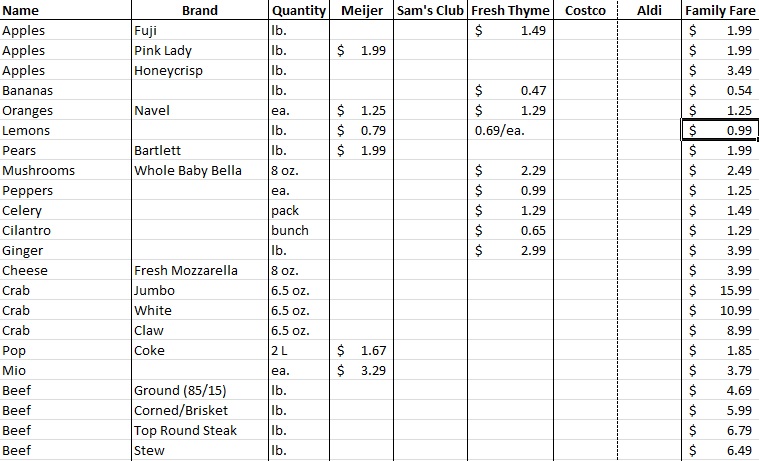
Since we are on an even tighter grocery budget, I want to make sure that I'm getting the best deals on food and other staples that we need. To that end, I made a comparison list (which you are welcome to download). I made the original list in my bullet journal, but you can type out some of the staples on the computer, print out the list and then fill in as you go. Or keep it on your phone (I like Excel documents that I can pull up from Dropbox on my phone - just remember to make it available offline before you leave wifi range).

Let's go through some things to look out for as you add to your list.

Stores: I compared prices at Meijer, Family Fare, Fresh Thyme, Sam's Club, Costco, and Aldi, since those stores are local to me. Aldi is a bit of a hike, as is Fresh Thyme, and Sam's Club and Costco are membership based (but each of our parents has access to one of those membership, so yay for us. If you're on a tight budget, you may want to find a friend with a membership or split one with someone). I also want to find a few local farmer's markets when the weather gets warmer, so I can compare prices there. Even if you think Whole Foods, Fresh Thyme, an organic market, or a farmer's market are out of your budget, you might want to go through and fill out your list there, since it may surprise you (for example, produce at Fresh Thyme is cheaper even than Meijer, I've found, and they often run specials).


Name: I am using this as the generic type (i.e. apples, rice, laundry detergent, beef, etc.).

Brand: This is the specific type. Fresh v. frozen, the fresh is the default for me, so I don't bother adding fresh behind produce, however I'll add it to mozarella because the default there is shredded/bagged (figure out what your defaults are and enter data accordingly). I buy most produce fresh, but I do buy frozen corn, so that would be Name: Corn, Brand: Frozen. Then also the sub-type, so Fuji, Pink Lady, Honeycrisp for Apples. Or the actual brand, i.e. the frozen juice we buy would be "Frozen, Old Orchard" or "Frozen, Minute Maid."

Quantity: the size it comes in, or the amount the price applies to. Some common ones - oz. (ounce), lb. (pound), ea. (each), 2L (2 Liter), can, 8 oz., etc. When it comes to cans and packages, I prefer to write down the amount in the can or package, because can and package sizes can vary. Often the signs will also tell you in very small print what the price per each or price per ounce is, so then I'll just do oz. and write down the per ounce price under the applicable store. Where quantities differ from store to store, this is especially important.

Under each store you chose: put down the dollar amount. If you are looking at by the pound ground beef, make sure you are comparing similar types of ground beef (85/15 versus 70/30 are going to be different), check the quantity on all packages so you're not comparing a 18 oz. bag at one store with a 22 oz. bag at another, also, check the value packs, those generally have the lowest prices. I write down whatever is lowest, knowing that if I do decide to buy something it will be the value pack and then I'll just break it up into smaller bags and throw the extra in the freezer for another meal.

Here is a portion of my list. I haven't filled out everything for every store. And as you can see, I am comparing pounds of lemons at Meijer and Family Fare to by the each at Fresh Thyme, so that's a little problematic.


To simplify your list: I like to go through and divide out differing amounts, so if Family Fare has 4 peppers for $5, I try to get it down to by the each. I also like to divide out by the size of the packs, so that I'm comparing ounces to ounces instead of a 18 oz. pack to a 32 oz. pack. If I look at two different sizes of the same cat food, and one is clearly cheaper, I remove the more expensive one from the list. Same with name brands, unless we greatly prefer one over the other, I'll remove the more expensive one. Don't forget to compare you favorite brand of toothpaste, deodorant, etc. although you may want to add some drug stores or a pet supply store into the mix for better comparison purposes.

How to use the list:

Knowing what to buy where. I'm not saying you need to go to every grocery store every week. That would negate your savings in gas and wear and tear on your car. I alternate going to Costco and Sam's Club once a month. After comparing prices between Family Fare and Meijer, I'll probably drop Family Fare from my list completely, because Meijer is cheaper across the board for my weekly shopping trip. And Aldi is only worth a trip if I know that several of the things I need that week are significantly cheaper than at Meijer, or if I want to stock up on fruit snacks, cereal bars, or pop tarts and other things that won't go bad very quickly.

Having a baseline idea of what things cost is helpful when you see a deal. Even if I go into Meijer for five things, I usually buzz by the meat section to see if they have any really good deals. Or you can read the online sales leaflets (or the paper ones, if you get those in the mail). We get most of our meat from Costco or Sam's Club, because it's just cheaper there and our chest freezer is rather large. However, sometimes the Meijer deals will blow the base prices at the other stores out of the water, and then I'll buy one or two to throw in the freezer. Spend a little money now to save a lot later on. Just make sure you're not buying something only because it's on sale. That's a waste of money if you're never going to eat/use it.

It's also good for comparing large amounts of things you know you'll use up, versus the smaller containers or by the each items. So if I know that Fuji apples are $1.99 per pound at Meijer for loose apples, and Sam's Club has a 3 pound bag of Fuji apples for $4, I know that it's cheaper to buy the bag (IF we are going to eat them all - i.e. I'm going to be making apple sauce or something). If you buy the bag and only eat 1 pound of apples before the rest goes bad, you've wasted money.

It lets you cost out your meals before you head to the grocery store. I meal plan and shop once a week (unless we run out of something important like milk halfway through the week). Knowing what my weekly budget is for groceries, plus what I already have on hand from shopping deals and Costco/Sam's Club, helps me when I sit down to make my meal plan. If we're really tight on money, I try to stick with the stuff we already have, plus what's cheap to buy at the store. I also try to keep a bit of wiggle room in that budget, in case I do see a really good deal while I'm out.

Buying name brand instead of generic. Sometimes I'll find a coupon or a deal so the usually more expensive name brand is cheaper or the same price as the generic. This matters mostly for things where you actually care about the taste, but maybe name brand just isn't in the budget. For me that's ice cream. I can always get generic for $2.99 a quart, but sometimes Hudsonville ice cream or Breyer's is marked down and then I like to get those instead, because I just like the taste better, but generic ice cream is better than no ice cream in my book. Also, ice cream is great freezer fodder if you have a large chest freezer like we do. Because it runs much more efficiently when it's full, we try to keep a bag of ice in there, and cheap stuff like ice cream and bread, so we're not filling it to the brim with expensive meats. The opposite may also be true. I don't like the generic Sam's Club diapers, so I buy Pampers when I go there. However, the Kirkland brand at Costco is just fine. So I like to be able to compare the lowest cost Pampers at Sam's Club with the generic (Kirkland) brand at Costco by the each by size (my kids are in Size 2 and 5 right now).

Shopping elsewhere. Maybe you stumbled across a new grocery store or a farmer's market/stand on a route you don't usually take. You've got your comparison list and your grocery list in your pocket or on your phone or in your planner. And because you're already here, it's not wasted gas because you weren't going to multiple stores.

Tuesday, September 22, 2015

Date Night on a Budget

My husband and I had our six year anniversary yesterday and decided to go to Olive Garden. We are currently living on one salary (mine, while he stays home with our kid), so it just wasn't in the budget to go somewhere fancy. In fact Olive Garden wasn't even in the budget, but I decided we needed a date night without our almost seven month old. So out we went.

Since we were on a budget, we skipped the alcohol. Restaurants upcharge that like you wouldn't believe (since they sell most wines and liquor by the pour, they generally make 70-80% profit on a bottle). Instead we agreed to pull out a bottle of wine at home.


Olive Garden gives you free bread sticks and salad, so I try to fill up on those and then take part of my entree home for lunch the next day (another money saver). We also skipped the appetizer, but since my husband really wanted the calamari appetizer, he got it as his entree instead, with a soup. Appetizers are generally much cheaper options than a main course, and we got a heaping plate of calamari when a pasta dish with a sprinkling of calamari might run you almost twice that and you end up getting a bunch of pasta which is extremely cheap for the restaurant to buy. Restaurants make their money on things like pizza, pasta, and various other dishes where they have a lot of cheap "filler" so they can skimp on the expensive stuff like meat and seafood.

Since we filled up on bread sticks and salad, we also skipped the dessert. However, and this is important, if you don't have a lot of money, skip an appetizer, but do NOT skimp on the tip. That waiter or waitress worked just as hard to please us on a $32 check as she would have if we'd also gotten drinks, appetizers, dessert, and coffee. And it's not her fault that the restaurant she works for gives away unlimited bread sticks and salad to the diners. It's not fair to punish the server just because you're trying to save some money. If I have a set budget for dinner, I prefer to cut down on a drink or dessert, rather than run out of money to leave a good tip.

After our dinner we walked home, both to burn off some of the heavy calories of the pasta and bread, and to save wear and tear and gas on the car (which is actually a lie that we were telling ourselves, because the real reason why we couldn't even really afford a trip to Olive Garden is because our car needs to go in to be repaired after my recent accident and we'll be paying a $250 deductible to get it fixed). But the walk did give us a bit more time away from our kid, who was safely ensconced with a friend who'd offered to watch him (for free, because he loves our kid, and potentially in the hopes of reciprocation once he has a kid of his own, which we will be happy to do). And it gave us time to talk and just generally catch up on our day and the past year of married life.


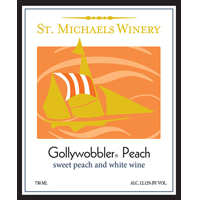
We got home and after putting our kid to bed and thanking our friend profusely (and politely shooing him out the door, after making plans with him later in the week, so we could have the rest of the evening to ourselves), we opened that bottle of wine ($12-$14 Gollywobbler Peach from St. Michael's Winery). This is way cheaper than drinking a bottle or 4-6 glasses at a restaurant any day, and amazing to boot! If you haven't had the Gollywobbler Peach, I highly recommend it if you can get your hands on it. It's made by a small winery in Maryland, and is sweet like a dessert wine but cheaper than most dessert wines, and even my husband who is not usually a sweet wine sort of guy, loves it.

We watched an episode of Leverage on the laptop, while snuggling together in bed and drinking our wine. This saved us a boatload instead of going to the movies, especially since my husband is one of those people who has to buy a drink at the concession stand when we go to a movie, and maybe some popcorn or candy too. And we were nice and cozy at home to boot. We also had access to ice cream, but since the wine was so sweet, it satisfied our cravings for dessert as well.